Howard Vassar, 77, of Polson, Montana and formerly of Trona, California, passed away June 6, 2014 at his home after a long battle with cancer.
Howard was born on September 24, 1936 in Amarillo, Texas to William and Willie Vassar. He grew up in southern California between Trona and Bishop. He worked for his dad sacking salt and driving trucks until he was drafted into the Army serving in the 101st Airborne, Screaming Eagles.
On September 11th, 1961, he married Deanna Marie Garner, settling in Trona building a family and a successful equipment contracting business until he retired 1982 and they moved to Polson, Montana.
Howard helped build and sponsor little league football in Trona, as well as sponsoring the high school football team. He was one of the founders of the first motorcycle clubs in southern California-The Sidewinders.
Howard enjoyed many outdoor activities; such as, motorcycling, dune buggies, water skiing, horseback riding, rodeos, roping, hunting and fishing. His one true passion that he developed over his life time was the love of trap shooting. He won the prestigious Butte Rod & Gun Club Medal in 1999 and attended the ATA World Championship in Vandalia, Ohio with his team mates in 2003. In his career he shot 84, 125 single targets, 93, 800 handicap targets and 65, 250 doubles targets for a grand total of 243, 275 registered targets since 1988.
He is preceded in death by his father William Charles Vassar, mother Willie Lee Vassar, step-father Clifford C. Jones; sisters Margie Conrad and Juanita Vassar and his brothers Edward and Bobby Vassar.
He is survived by his wife Deanna Vassar; children Renee Morgan (Larry Morgan), Radean Vassar (Ryan Boden), Howard ‘Howdy’ Vassar (Debbie Sargent-Vassar) and Tina Vassar-Buser (Mike Buser); seven grandchildren Chad Morgan, Jill (Morgan) Marlow, Aaron Morgan, Christopher Vassar, Caitlyn Vassar, Amber Caraway and Rainee Vassar; eight great-grandchildren and one great-great grandchild. Howard is also survived by his brother John Vassar and numerous nieces and nephews that he loved dearly.
A celebration of his life will be held Friday, June 13th at 11:00 am at Grogan Funeral Home and Crematory. Burial will follow at Lakeview Cemetery. – See more at: http://www.groganfuneralhome.com/obituary/William-Howard-Vassar/Polson-MT/1389301#sthash.oMOw5QxW.dpuf


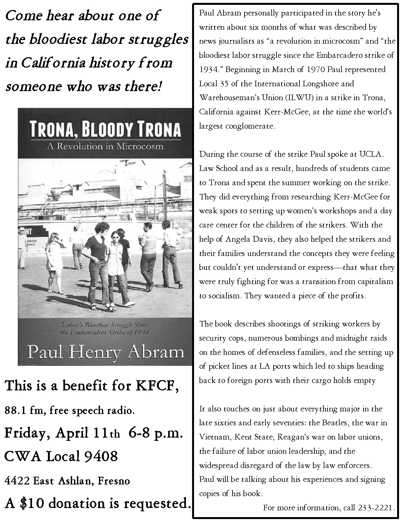 I have meet a lot of lawyers who work on social and economic justice issues but have never met one quite like Paul Henry Abram. I look forward to his visit to Fresno on Friday, when he will appear in a benefit for listener sponsored radio station KFCF (see details below). Abram has written an extraordinary account of his experience representing the union members in ILWU local 35 who were on strike in Trona Ca in 1970. Most lawyers are more cautious (some would say conservative) than the activists they represent, but Abram gains the trust of the workers by being as militant as they are and willing to share the risks needed to win.